
Outreach
Since its creation, Into the Winds has placed transmission at the heart of its artistic project. Bringing the wind instruments of the Middle Ages and the Renaissance to life is not only about performing a rare repertoire; it is also about conveying a historical context, performance practices, and ways of listening.
Our educational activities are built around three complementary pillars:
- Understanding: placing the works within their historical, political, and social context, and discovering the role they played in the society of their time,
- Experimenting: practicing music, rhythm, and movement based on early sources in order to experience their principles firsthand,
- Interpreting: making stylistic choices grounded in historical sources and offering a coherent interpretation designed for today’s audiences.
We work with school pupils, conservatories, and higher education institutions through flexible formats, developed in consultation with teaching teams and tailored to the specific objectives of each institution.
Projects in Primary and Secondary Schools
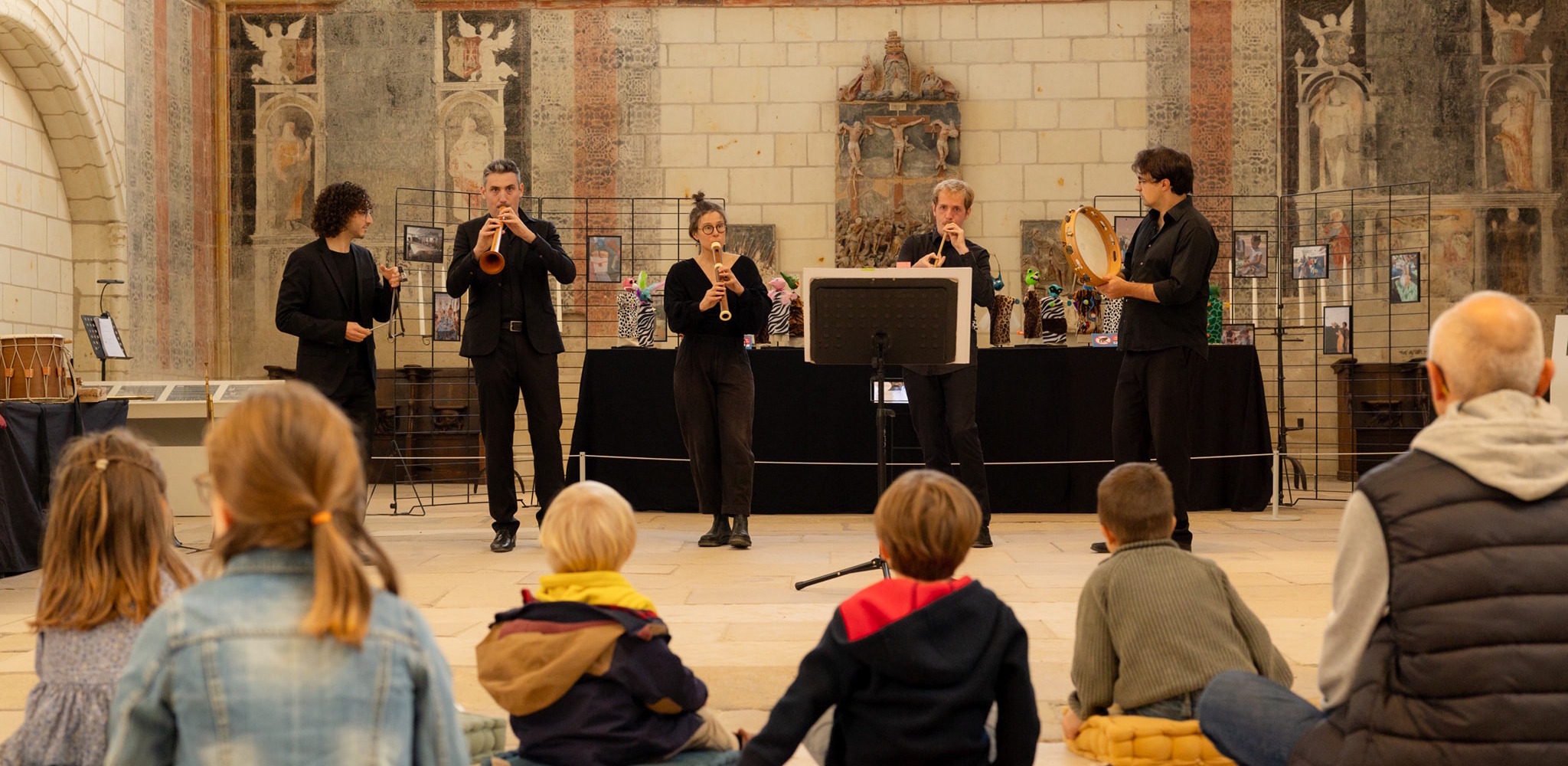
Into the Winds works in primary schools, middle schools, and high schools as part of arts and cultural education projects linked to the national curriculum.
The proposed program unfolds over several sessions throughout the year, combining historical context, music, dance, spoken text, and collective writing. It particularly develops an understanding of historical and cultural contexts, active listening, ensemble playing, bodily and rhythmic awareness, public speaking, and the appropriation of artistic heritage.
Each project may culminate in a public performance designed to showcase the students’ work.
Example project: “The Field of the Cloth of Gold – A Renaissance Diplomatic Celebration”, developed with Collège François Villon (Paris 14th district) as part of the City of Paris “Art pour Grandir” program and a residency at the Pavillon de la Sirène.
Work in Conservatories: The Educational Renaissance Ball
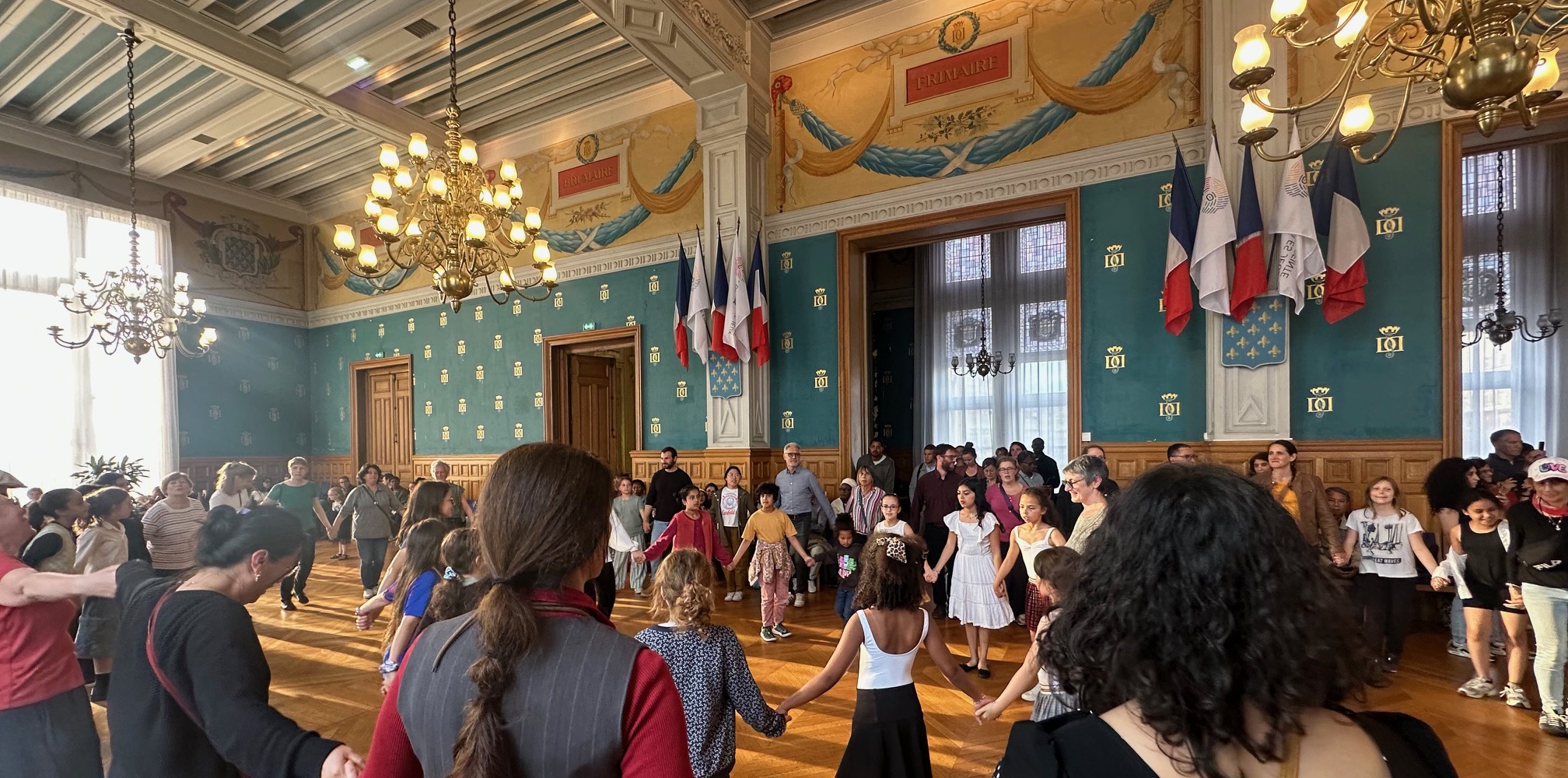
A unifying and cross-disciplinary project, the Educational Renaissance Ball brings together instrumentalists, singers, dancers, and music theory students within the same institution around a shared artistic experience.
The Educational Renaissance Ball enables students to:
- Anchor their playing in movement by understanding concretely the impact of pulse, tempo, dynamics, and musical energy on the dancer’s body,
- Develop active and responsive listening, attentive to the interaction between music and dance,
- Deepen their understanding of historical practices by exploring ornamentation, improvisation, and the adaptation of written models,
- Expand their modes of learning, notably through memorization and oral transmission,
- Strengthen their sense of ensemble by assuming individual responsibility within a real performance setting,
- Give meaning to the works studied by placing them within their historical and social context.
The project involves one or several sessions led by musicians from the ensemble and culminates in a participatory public performance. It can be adapted according to the institution’s size, levels, disciplines, and resources.
This project has notably been carried out in numerous conservatories and music schools: Conservatories of Garches, Saint-Denis, La Flèche, CRR of Boulogne-Billancourt, etc.
Work in Higher Education
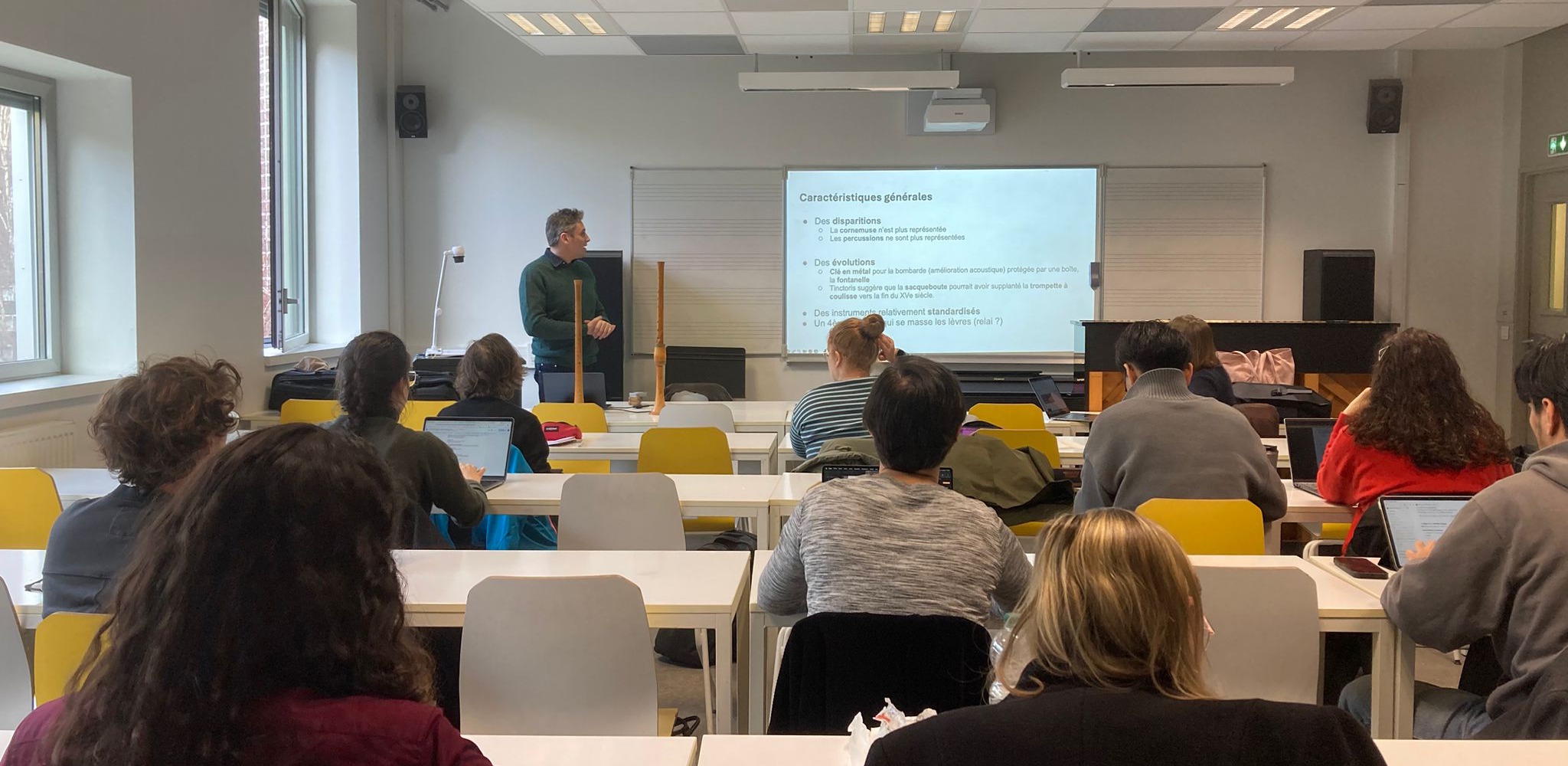
Into the Winds contributes to higher education programs (universities, advanced music institutions, musicology seminars) on issues related to the interpretation of Medieval and Renaissance music. These sessions may focus in particular on:
- Wind bands of the 15th and 16th centuries: organology, social functions, and repertoire,
- The adaptation of fragmentary sources to instrumental ensembles,
- Historically informed performance practices (improvisation, articulation, diminutions, etc.),
- Contemporary staging of early repertoires.
These activities may take the form of lecture-demonstrations, analytical seminars, or practical workshops.
Example project: Lecture “Wind Bands in the Middle Ages and the Renaissance: Sources, Practices, and Interpretation” as part of the course “History of Early Music Performance Practice” within the Master’s program in Music and Musicology at the Sorbonne (Paris).
Masterclasses
The ensemble also offers masterclasses dedicated to the interpretation of Medieval and Renaissance music, on historical or modern instruments. Depending on the context, these sessions may focus on historically informed performance of Medieval or Renaissance repertoire, the relationship between music and dance, or the making and playing of historical reeds.